



Assembly Line Conveyor for Automation
Rapid Deployment via Assembly Line Conveyor for Automation
An Assembly Line Conveyor for Automation improves production flow by providing a rigid, high-precision backbone for robotic integration and component transport. These sophisticated Assembly Line Conveyor for Automation systems utilize modular chassis designs to allow for rapid deployment in customized industrial applications. Consequently, process engineers can achieve greater throughput by synchronizing part positioning with automated downstream tasks.
Why Engineers Value an Assembly Line Conveyor for Automation
Modern manufacturing demands speed and adaptability. Therefore, an Assembly Line Conveyor for Automation is the core component of any agile facility. Traditional conveyors often lack the precision required for robotic interaction. However, modern automated material handling equipment provides sub-millimeter accuracy. This level of detail is necessary for delicate electronic assembly and heavy automotive welding alike.
Because these systems use standardized mounting points, engineers can attach sensors or stops instantly. This flexibility significantly reduces the time spent on mechanical engineering during the setup phase. Furthermore, the use of an Assembly Line Conveyor for Automation ensures that parts arrive at each station in the correct orientation. This predictability eliminates the need for expensive vision systems at every single point of the line.
Technical Advantages of Modular Integration
Feature | Impact on Deployment | Engineering Benefit |
T-Slot Framework | Rapid attachment of peripherals | Reduced fabrication time |
Precision Pallets | Consistent part datum | Higher robotic accuracy |
Distributed I/O | Faster electrical integration | Simplified PLC programming |
Cleanroom Compatibility | Meets ISO standards | Versatile industry usage |
CDS LIPE utilizes extensive field experience to refine these mechanical structures. We understand that a rigid frame is the foundation of a reliable system. Thus, our automated material handling equipment maintains its alignment even under heavy, continuous loads.
Optimizing Workflows with Automated Material Handling Equipment
Effective automation requires seamless communication between hardware and software. Automated material handling equipment serves as the physical link in this digital chain. For instance, an Assembly Line Conveyor for Automation can report its speed and part count directly to a central dashboard. This data allows process engineers to identify bottlenecks in real-time.
Moreover, advanced drive systems allow for "soft starts" and "soft stops." This feature protects sensitive components from mechanical shock during transport. As a result, scrap rates decrease and overall equipment effectiveness (OEE) increases. Additionally, integrating Modular Belt Conveyors into the line allows for complex pathing. You can move parts around corners or through vertical elevators without losing control of the product. Consequently, manufacturers can fit more production capacity into a smaller footprint.
Enhancing Throughput with Modular Belt Conveyors
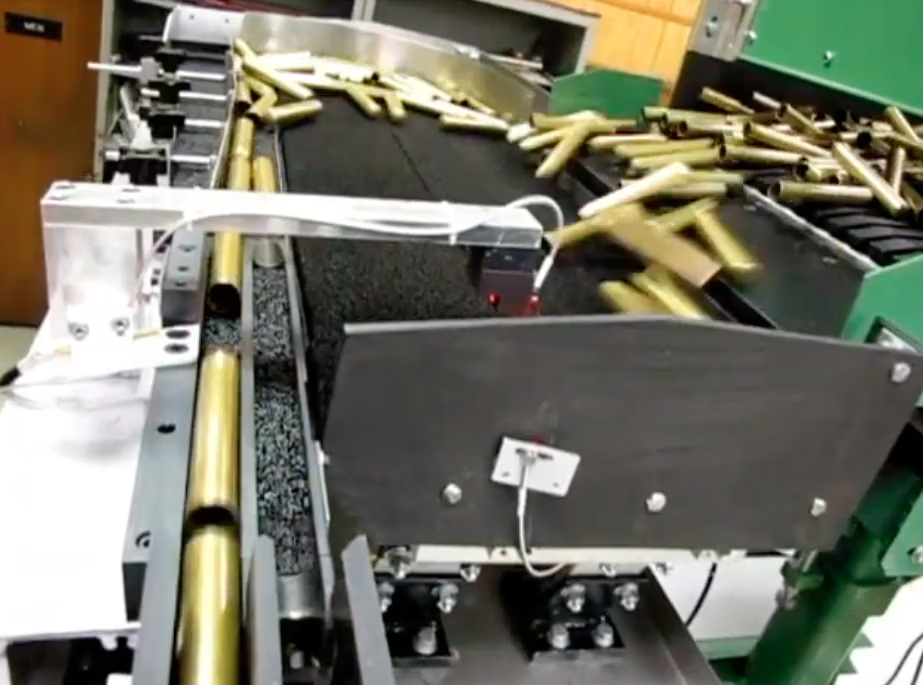
Modular Belt Conveyors provide a robust solution for high-volume environments. These belts consist of interlocking plastic segments that offer high tensile strength. Unlike rubber belts, they do not stretch or wander over time. Therefore, they are ideal for an Assembly Line Conveyor for Automation where timing is critical.
- Easy Maintenance: Replace individual damaged links in minutes without tools.
- High Load Capacity: Handle heavy metal castings or bulk containers with ease.
- Chemical Resistance: Survive washdown environments and industrial lubricants.
By choosing these engineered material handling solutions, you ensure the longevity of your investment. CDS LIPE specializes in selecting the exact belt pitch and material for your specific environment. Whether you handle oily parts or sterile medical devices, we provide the correct technical surface. Ultimately, a well-engineered belt reduces friction and lowers energy consumption.
Customizing Your Assembly Line Conveyor for Automation
Every production floor has unique spatial and mechanical constraints. Because of this, we design our Assembly Line Conveyor for Automation systems to be highly customizable. We can incorporate lift-and-locate stations for high-precision tasks. Furthermore, we can add diverters to route parts to different testing stations.
This adaptability makes our automated material handling equipment a favorite among process engineers. We focus on the rigors of the industry by using heavy-duty bearings and reinforced drive shafts. As a premier automated material handling systems expert, CDS LIPE provides the documentation and support needed for rapid validation. This ensures your new Assembly Line Conveyor for Automation meets all safety and performance benchmarks before the first shift begins.
Expert Q&A: Assembly Line Automation
Q. How does an Assembly Line Conveyor for Automation improve flow?
It provides a constant, metered speed that eliminates the gaps and surges typical of manual transport.
Q. Why are Modular Belt Conveyors preferred for long lines?
Their interlocking design prevents the tracking issues and stretching commonly found in traditional long-run fabric belts.
Q. What is the role of automated material handling equipment in safety?
It automates heavy lifting and repetitive movements, which reduces the risk of ergonomic injuries for your workforce.
Q. Can an Assembly Line Conveyor for Automation handle varied part sizes?
Yes, these systems can be designed with adjustable guides or custom pallets to accommodate multiple product SKUs on a single line.
Q. How does CDS LIPE support the installation process?
We provide full CAD layouts and pre-shipment testing to ensure the system integrates perfectly with your existing factory floor.
Partner with CDS LIPE today as your trusted engineering partner for advanced assembly line solutions. Contact us today