



Exploring Assembly Automation and Delicate Component Handling for Enhanced Production
Medical device assembly automation refers to the use of mechanized systems to perform repeatable assembly, handling, inspection, and packaging tasks for medical products, improving precision and consistency across production. This article explains how automation solves delicate component handling challenges, reduces surface damage, and raises yield for devices such as surgical instruments and IVD cartridges. Readers will learn core automation mechanisms, the role of gentle parts feeding, specific applications in IVD manufacturing, and how automation maps to regulatory and supply-chain problems. The discussion emphasizes precision surgical instrument handling, automated IVD test strip assembly, and quality-control automation while showing practical examples and technology choices. Each section provides concise explanations, short lists of benefits or applications, and EAV tables that clarify how components, attributes, and values align with automated solutions. By the end, you will understand why gentle feeder technology and integrated inspection matter to modern medical device manufacturing.
What is Medical Device Assembly Automation and Why is it Essential?
Medical device assembly automation is the application of coordinated machines and controls to perform assembly steps with repeatable precision, reducing variability and human-induced defects. It works by combining controlled feeders, robotic or gantry placement, vision inspection, and traceability systems to ensure that each part is handled and documented consistently. The result is higher throughput, lower scrap, and measurable process traceability that supports regulatory expectations such as ISO 13485 and FDA quality-system principles. Below is a short overview of the main reasons manufacturers adopt automation and the top benefits that drive investment.
Medical device assembly automation delivers three primary benefits:
- Increased precision and repeatability: automated motion control reduces part-to-part variation.
- Faster throughput and consistent cycle times: automation enables predictable production rates.
- Traceability and integrated inspection: data capture supports quality audits and recalls.
These advantages reduce rework and provide a foundation for integrating downstream inspections and packaging steps.
CDS-Lipe can serve as a practical example of a provider that offers automation equipment suited for delicate parts handling. Their Dyna-Slide gentle parts feeders are designed to feed sensitive components without marking or scratching, and they integrate with vision systems and quick-change tooling to support mixed-product lines. This brief example illustrates how suppliers translate automation concepts into machine features without prescribing a single solution.
How Does Automation Improve Medical Device Production Processes?
Automation improves medical device production by enforcing consistent handling, orientation control, and inline inspection, which together reduce defects and enable higher throughput. Automated feeders present parts in controlled orientation to assembly stations, robotic actuators place or join components with known repeatability, and vision inspection validates critical dimensions or surface conditions before packaging. This combination reduces operator variability and enables 24/7 operation with predictable yields. For example, an automated line that feeds, assembles, inspects, and serializes components can provide traceable lot histories while maintaining cleanroom-compatible workflows, which shortens time-to-release and increases overall equipment effectiveness.
What Are the Benefits of Automated Surgical Instrument Manufacturing?
Automated surgical instrument manufacturing protects finished surfaces, ensures assembly accuracy, and streamlines tray assembly for sterilization readiness. By using gentle handling and non-marking contact surfaces, automated systems minimize scratches on polished instruments and preserve functional tolerances for jaws, hinges, and locking features. Consistent assembly also supports sterilization fit and reduces rework on high-value parts, lowering cost per usable instrument. Automation further enables repeatable tray population and labeling, improving downstream logistics and reducing manual errors that can delay product release.
| Component Type | Handling Challenge | Automated Solution |
|---|---|---|
| Delicate jaws and polished surfaces | Surface marring, misalignment | Gentle parts feeders + soft tooling to prevent abrasion |
| Small screws and fasteners | Orientation and drop risk | Controlled vibratory or slide feeders with singulation |
| Glass or sensor elements | Fragility and contamination | Low-impact transport and enclosed handling with vision checks |
This table compares common surgical instrument components, typical handling risks, and automated approaches that mitigate those risks. The mapping shows how gentle feeding paired with inspection addresses both physical damage and alignment accuracy.
How Does Gentle Parts Feeding Enhance Delicate Medical Component Handling?
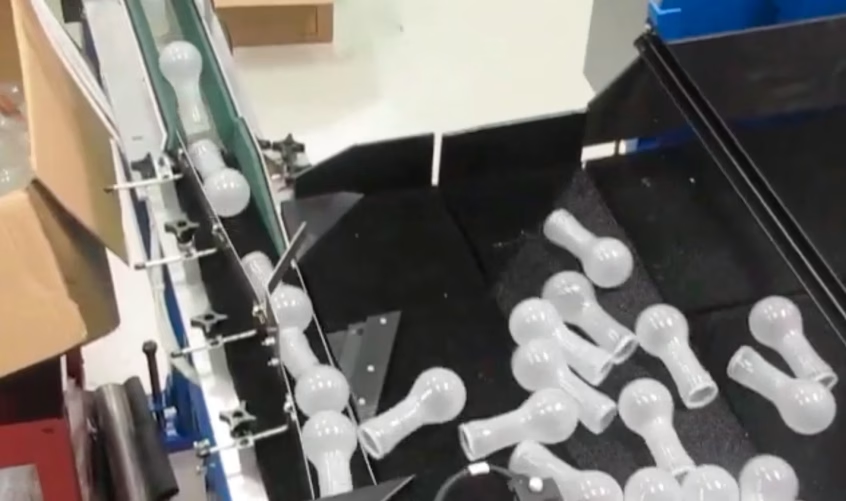
Gentle parts feeding refers to feeder systems engineered to convey, singulate, and orient components using low-impact motion and non-marking contact, enabling automation for fragile or finished-surface medical parts. The mechanism relies on controlled acceleration, soft contact surfaces, and precise tooling that reduce contact forces while maintaining part flow, which minimizes scratches and internal stresses. The outcome is lower scrap, more consistent downstream assembly, and the ability to automate processes that would otherwise require hand assembly. The following list highlights common delicate medical parts that benefit from gentle feeding.
Gentle feeding protects these delicate part types:
- Finished-metal components with polished surfaces.
- Thin glass elements and optical parts used in diagnostic devices.
- Soft-coated or polymer parts susceptible to abrasion.
What Makes Dyna-Slide Technology Ideal for Fragile Medical Components?
Dyna-Slide technology employs a controlled slide mechanism with non-marking contact surfaces and low-impact motion to present parts gently to downstream operations. Its core features include quiet operation, low acceleration profiles, and quick-change tooling to handle families of parts without long retooling times. These attributes reduce surface abrasion and particle generation, while compatibility with high-speed vision and gentle rejection mechanisms allows integrated quality assurance on the line. A practical example is feeding polished instrument tips into an assembly cell where surface integrity is critical; Dyna-Slide reduces contact events that could create blemishes.
| Feature | Attribute | Value |
|---|---|---|
| Contact surface | Material and finish | Non-marking, low-friction |
| Handling force | Typical acceleration | Low-impact, controlled motion |
| Noise | Operational characteristic | Quiet operation suitable for lab environments |
This EAV table summarizes core Dyna-Slide attributes and their values to show technical fit for fragile medical components. The concise mapping clarifies why these features matter during high-throughput, high-quality assembly.
How Does Gentle Feeding Minimize Damage and Maximize Quality?
Gentle feeding minimizes damage by reducing physical stress on parts through controlled transport, orientation fidelity, and accumulation without jamming. Lower contact forces decrease micro-abrasion and preserve critical surface finishes, which directly reduces downstream inspection failures and rework. Controlled orientation improves pick-and-place accuracy, allowing vision-guided actuators to align components for precise joining or bonding. As an example, using gentle accumulation ahead of an assembly station smooths flow and prevents intermittent jams that otherwise raise cycle times and increase part handling incidents.
What Are Key Applications of Automation in IVD Manufacturing?
Automation in IVD manufacturing applies to test strip and cartridge assembly, reagent dispensing, cassette insertion, and kit packaging, each requiring precise handling and contamination control. Automated systems deliver consistent placement of membrane strips, accurate dosing of reagents, and sealed packaging with inspection to confirm completeness. These capabilities reduce contamination risk, improve lot-to-lot consistency, and enable traceable records for each kit or cartridge. The next list outlines core IVD automation applications and the specific benefit each delivers.
The principles of automated manufacturing are particularly vital in the production of diagnostic tools like lateral-flow assays, where precision and consistency are paramount.
Automated Manufacturing for Lateral-Flow Assays
This chapter discusses materials selection, product design and tolerancing, and automated manufacturing processes to help in the efficient and cost-effective design and manufacture of lateral-flow assays. Raw materials including filter materials, membranes, and adhesives are discussed. A detailed discussion on properly dimensioning and tolerancing a typical lateral-flow laminate is provided. Several illustrations are provided to help in the understanding of proper dimensioning practices and to illustrate potentially problematic housing designs. The chapter concludes with six automation imperatives—six ideas that will help to ensure the successful and cost-effective implementation of automated manufacturing processes for the high-volume manufacturing environment.
Lateral-flow assays: assembly and automation, 2005
Key IVD automation applications include:
- Automated assembly of test strips and cartridges: improves placement accuracy and throughput.
- Reagent handling and dispensing: ensures dosing precision and reduces cross-contamination risk.
- Kit packaging and inspection: verifies completeness and seals kits reliably for distribution.
These targeted applications enable manufacturers to scale production while maintaining clinical-grade cleanliness and traceability.
How Is Automated Assembly Used in IVD Kit Production?
Automated assembly for IVD kits handles small components such as cassettes, pads, and membranes with precision placement and contamination controls to meet clinical sensitivity requirements. Machines singulate strips, align components, and bond or seal subassemblies with consistent pressure and timing, which preserves assay performance. Inline vision inspection confirms placement and cleanliness before kits move to packaging, reducing recalls and increasing first-pass yield. Automation also allows parallel processing of multiple kit variants using quick-change tooling, maintaining flexibility for small-batch production.
| IVD Component | Process Step | Benefit of Automation |
|---|---|---|
| Test strip membranes | Placement and alignment | Precise positioning reduces assay variability |
| Reagents (vials/cartridges) | Dosing and sealing | Consistent volumes and reduced contamination |
| Kit contents (labels, inserts) | Assembly and inspection | Ensures completeness and correct lot labeling |
This table shows where automation applies within IVD workflows and the measurable benefits it brings, emphasizing dosing accuracy and contamination control in reagent handling.
What Role Does Automation Play in Reagent Handling and Packaging?
Automation ensures dosing accuracy, containment, and traceable packaging for reagents through precision metering pumps, enclosed transfer systems, and serialization-enabled labeling. Controlled dispensing reduces variance in reagent volumes that can affect assay sensitivity, while contained handling minimizes operator exposure and cross-contamination. Automated capping, sealing, and labeling integrate with traceability systems to record batch data and support lot-level recall management. These systems make reagent production both safer and more consistent for clinical applications.
How Does Automation Address Challenges in Medical Device Manufacturing?
Automation addresses core manufacturing challenges—quality variation, regulatory documentation, and supply chain responsiveness—by embedding inspection, data capture, and modular flexibility into production lines. Automated inspection catches defects early, data systems record process parameters for audits, and modular equipment with quick-change tooling allows rapid product mix changes to respond to demand variability. Together, these elements reduce scrap, improve on-time delivery, and support compliance with regulatory expectations. The following problem-solution list pairs common challenges with automated remedies.
Problem-solution pairings for automation:
- Quality variability → Automated vision inspection and inline measurement reduce defects.
- Regulatory traceability → Integrated data capture logs process parameters for audits.
- Supply-chain agility → Modular lines and quick-change tooling enable faster product switches.
These targeted solutions help manufacturers minimize risk while scaling production efficiently.
How Does Automation Support Regulatory Compliance and Quality Control?
Automation supports compliance by providing consistent processing, integrated inspection, and automated data capture that together create auditable records required for quality systems. Vision modules detect surface defects and assembly errors before parts are released, while serialization and lot tracking capture component origins and assembly history for each device. Consistent process control reduces batch variability and simplifies validation activities, making it easier to demonstrate process capability during regulatory reviews. Automated systems therefore form a technical backbone for meeting ISO and FDA expectations around traceability and quality assurance.
Further emphasizing the critical role of advanced inspection, recent research highlights the effectiveness of automated vision systems in ensuring the quality of medical instruments.
Automated Vision Systems for Medical Instrument Quality Inspection
The article investigates the application of vision systems, enhanced by advanced image processing algorithms, in quality inspection processes for medical instruments, addressing the limitations of traditional manual inspection methods. The study focuses on the use of a Keyence vision system equipped with advanced image processing algorithms and LumiTrax technology to detect defects in surgical needle holders. A pilot study was conducted, developing and verifying five inspection programs through controlled experiments with 75 test samples containing known defects. The results demonstrated high effectiveness of the vision system, achieving 100% accuracy in detecting solder and joint defects, although challenges were observed in identifying surface defects, leading to two Type II errors. Compared to manual inspection, the automated system significantly enhanced speed, repeatability, and accuracy while reducing inspection time.
What Solutions Improve Supply Chain Resilience and Production Efficiency?
Supply chain resilience and production efficiency improve with modular automation, quick-change tooling, and predictive maintenance that together reduce downtime and enable flexible production mixes. Modular stations allow manufacturers to reconp lines quickly for different SKUs, while quick-change tooling shortens changeover times and supports smaller lot sizes economically. Digital monitoring and predictive alerts on critical equipment lower unplanned downtime by addressing wear before failures occur. Implementing these solutions enables manufacturers to respond to shifting demand without sacrificing quality or throughput.
For manufacturers exploring gentle parts feeding solutions in medical production, these automation strategies clarify how careful feeder design, integrated inspection, and modular system architecture work together to protect delicate components and support compliant, efficient manufacturing. For more technical discussions about gentle-feeder integration and vision-enabled quality assurance, consider engaging with specialists who can map these approaches to your specific device and process needs.