



Solving Bulk Supply Issues with a Long Part Conveyor
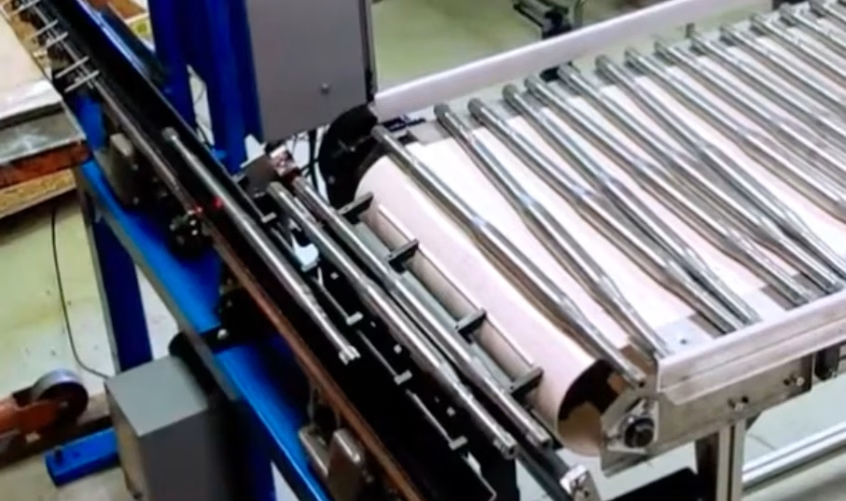
A Long Part Conveyor solves integrated bulk supply issues by providing stable, oriented transport for high-aspect-ratio components that typically jam standard feeding systems. These specialized Long Part Conveyor systems synchronize with automated material handling equipment to eliminate manual sorting, thereby ensuring a continuous, high-speed production flow in aerospace and automotive assembly.
Comparing Standard vs. Long Part Conveyance
| Feature | Standard Conveyor | Long Part Conveyor |
| Part Stability | Low for high-aspect ratios | High via specialized nesting |
| Orientation | Random or bulk | Fixed longitudinal or lateral |
| Throughput | High for small fasteners | Optimized for shafts and rods |
| Jam Rate | High with interlocking parts | Minimal due to singulation |
CDS LIPE leverages decades of industrial experience to refine these designs. We recognize that automotive drivetrain components require different handling than aerospace hydraulic lines. Thus, our engineered material handling solutions offer the rigidity needed for heavy steel and the finesse required for lightweight composites.
Optimizing Workflows with Automated Material Handling Equipment
Integrating a Long Part Conveyor into a larger cell requires advanced automated material handling equipment. Modern systems use programmable logic controllers (PLCs) to manage part spacing. For instance, the system can detect a downstream delay and pause the feed instantly. This intelligent communication prevents “bird-nesting,” which is a common failure in bulk supply chains.
Moreover, high-speed sensors monitor the center of gravity for every piece. Because long parts are prone to tipping, these sensors trigger micro-adjustments in the belt speed. As a result, the assembly line maintains a consistent cadence. This predictability allows engineers to calculate exact cycle times. Consequently, facility managers can optimize labor shifts and reduce idle power consumption across the floor.
Achieving Throughput via Engineered Material Handling Solutions
True efficiency stems from engineered material handling solutions that address the physics of the component. Long parts often have a high moment of inertia. Therefore, rapid starts and stops can cause parts to slide or lose their datum position. Our Long Part Conveyor designs include high-friction materials and custom cleats. These features lock the part in place during high-acceleration phases.
- Precision Singulation: Separates individual parts from a bulk hopper.
- Dynamic Gapping: Ensures the robot has enough space to clear the conveyor.
- Multi-Axis Tracking: Monitors the part across X, Y, and Z planes.
Additionally, CDS LIPE focuses on “Plug-and-Play” integration. We design our Long Part Conveyor units to bolt directly into existing production architectures. This modularity minimizes installation downtime. Hence, your facility can upgrade its bulk supply system without a lengthy shutdown.

Technical Rigor in Aerospace and Automotive Sectors
The aerospace sector demands strict adherence to AS9100 standards for part handling. Similarly, automotive Tier 1 suppliers follow IATF 16949 protocols. A Long Part Conveyor helps meet these requirements by providing “Gentle Touch” transport. Because parts do not rub against each other, the risk of surface marring or structural fatigue is eliminated.
Furthermore, automated material handling equipment provides full traceability. Every part on a Long Part Conveyor can be scanned and logged into a central database. This data loop ensures that any defect is traced back to a specific timestamp. Consequently, manufacturers can perform surgical recalls rather than broad, expensive ones.
The CDS LIPE Difference
As a premier automated material handling systems expert, CDS LIPE delivers more than just hardware. We provide a complete technical ecosystem. Our Long Part Conveyor solutions are tested under simulated load conditions before they ever reach your dock. Thus, we ensure that your engineered material handling solutions perform exactly as modeled in the CAD environment.
Expert Q&A: Long Part Bulk Supply Systems
Q. How does a Long Part Conveyor prevent part jamming?
It uses longitudinal guides and singulators to ensure parts stay parallel, preventing the “interlocking” effect of bulk storage.
Q. Can these systems handle different materials, like carbon fiber or titanium?
Yes, our engineered material handling solutions utilize non-marring contact surfaces specifically designed for sensitive aerospace materials.
Q What role does automated material handling equipment play in safety?
It removes the need for operators to manually reach into hoppers or move heavy, awkward parts, significantly reducing workplace injuries.
Q Why is a Long Part Conveyor essential for robotic integration?
Robots require a precise “pick” location; this conveyor provides a consistent datum point that does not shift during transport.
Q How does CDS LIPE customize systems for specific factory footprints?
We offer modular belt lengths and varying incline angles to fit into tight automotive assembly cells without sacrificing throughput.
Contact CDS LIPE today to secure a trusted engineering partner for your next high-performance assembly project.