



How Automation Solves Integrated Bulk Supply System Issues
Integrated bulk supply systems utilize automation to eliminate manual handling bottlenecks and ensure a continuous, regulated flow of raw components. By deploying assembly conveyor systems, manufacturers can synchronize bulk hopper discharges with downstream production speeds to maximize total throughput.
Why Modern Engineers Prioritize Assembly Conveyor Systems
Process engineers face constant pressure to increase yield while reducing operational overhead. Consequently, the integration of automated material handling equipment has shifted from a luxury to a technical necessity. Manual bulk feeding often results in erratic flow rates or mechanical jams. However, sophisticated assembly conveyor systems provide the precise timing required for high-speed lines. These systems utilize sensors to monitor real-time data. Therefore, the equipment can adjust speeds instantly to prevent line starvation or overflow.
Key Benefits of Engineered Material Handling Solutions
When you invest in engineered material handling solutions, you are essentially buying predictable performance. Standard off-the-shelf components rarely meet the rigors of specialized manufacturing environments. Because of this, custom engineering ensures that every transition point is optimized for your specific part geometry.
| Feature | Impact on Production |
| Variable Frequency Drives | Smooth acceleration reduces component damage |
| Precision Sensors | Minimizes downtime via real-time jam detection |
| Modular Design | Allows for rapid scaling as demand grows |
Furthermore, CDS LIPE brings decades of expertise to every project. We understand that a single failure in a bulk supply system can halt an entire factory. Thus, our assembly conveyor systems are built for 24/7 durability.
Optimizing Workflows with Automated Material Handling Equipment
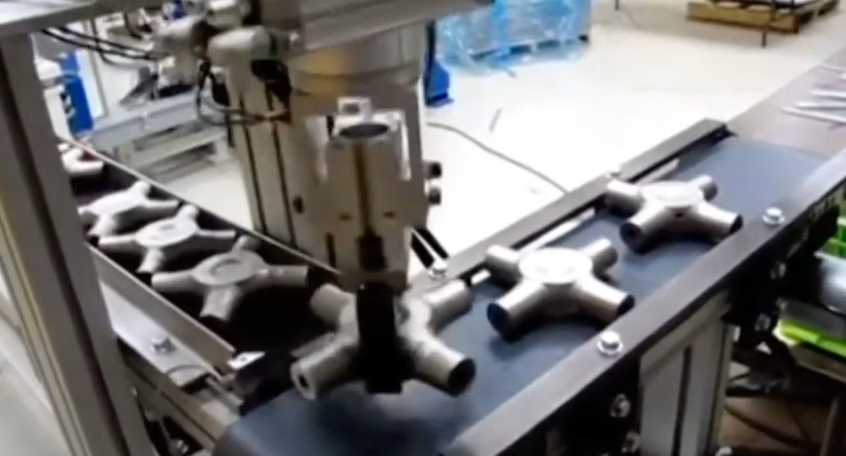
Effective automation requires more than just moving parts from point A to point B. Instead, it involves the intelligent orchestration of motion. Automated material handling equipment utilizes programmable logic controllers (PLCs) to manage complex sequences. For example, a bulk vibratory feeder must communicate seamlessly with the primary assembly conveyor systems. If these units are not synchronized, the resulting turbulence decreases efficiency.
Technical Advantages of Integration
Reduced Labor Costs: Automation removes the need for constant human intervention.
Improved Safety: Ergonomic hazards are eliminated by automating heavy lifting.
Enhanced Data Accuracy: Integrated systems track part counts with high precision.
Moreover, the implementation of engineered material handling solutions creates a closed-loop system. This means errors are caught before they reach the final assembly stage. Consequently, scrap rates drop significantly. Your team can then focus on higher-value tasks rather than basic material movement.
The Role of CDS LIPE in Advanced Manufacturing
Choosing the right partner is critical for successful system integration. CDS LIPE specializes in high-performance assembly conveyor systems that stand the test of time. Our team designs automated material handling equipment tailored to your unique facility constraints. Additionally, we prioritize ease of maintenance in every design.
By choosing engineered material handling solutions from an industry leader, you mitigate the risks of project delays. We provide comprehensive support from the initial CAD layout through final installation. Ultimately, our goal is to ensure your assembly conveyor systems deliver a rapid return on investment.
Expert Q&A: Integrated Bulk Supply Systems
1. How do assembly conveyor systems improve production flow? They provide a consistent, metered flow of parts, which eliminates the “stop-and-go” nature of manual feeding.
2. What is the main benefit of automated material handling equipment? The primary advantage is the optimization of workflows through precise, repeatable mechanical movements.
3. Why are engineered material handling solutions better than standard parts? Custom solutions are designed for specific part weights and sizes, ensuring higher reliability and less maintenance.
4. Can assembly conveyor systems be integrated into existing lines? Yes, modern systems are highly modular and can be retrofitted to sync with your current PLC architecture.
5. How does CDS LIPE ensure system longevity? We use heavy-duty materials and industry-leading components to withstand the rigors of continuous manufacturing.
Contact CDS LIPE today to partner with a trusted engineering expert for your next automation project.